

Story
Ending impunity, one day at a time!
- Date:
- Source:
- OSCE Mission in Kosovo
Independent journalism is essential to democracy. It holds those in power accountable, helps people make informed decisions, shapes public debate, and gives voice to different perspectives.
In today’s media landscape, marked by disinformation, online hostility, and growing pressure, professional and independent journalism matters more than ever. Yet journalists can face significant risks in their work.
The 2026 Shadow Report on Media Freedom in Kosovo highlights growing challenges for journalists, including pressure, online harassment, potential SLAPP lawsuits and insecure working conditions, with additional risks for women journalists.
Protecting journalists, ensuring access to legal support and ending impunity for crimes against them are therefore essential to safeguarding media freedom.
Journalists’ associations and their legal consultants play a vital role in providing this support. Since 2022, the OSCE Mission in Kosovo has supported the Kosovo Association of Journalists (AJK) with legal services, helping journalists access the assistance they need. On the occasion of the International Day to End Impunity for Crimes against Journalists, we sat down with Yll Zekaj, who is currently engaged by the Mission as legal consultant, to discuss how this consultancy has helped journalists understand and defend their rights, and address challenges they face.
How has the role of legal consultant contributed to the Association of Journalists of Kosovo’s efforts to protect journalists’ rights?
Zekaj: Working with journalists is never boring. News doesn’t follow a schedule, and neither do the challenges journalists face. When a journalist is threatened or needs urgent legal advice, support must be available when it matters most, not the next working day.
When the role of legal consultant was created in 2022, the duties involved providing legal advice and assistance to journalists facing a range of professional and employment-related challenges. Over time, this work has evolved into more continuous support, helping journalists understand their rights, explore available legal remedies and address issues that may affect their ability to work freely and safely.
Concretely, my work now includes providing legal assistance to journalists facing SLAPP-related proceedings, employment disputes and defamation claims, including cases involving substantial financial damages. I also assist journalists in challenging decisions affecting the programming schedule of the public broadcaster (RTK), support those facing lawsuits and claims brought by individuals and senior institutional representatives, and accompany journalists during Police questioning in connection with alleged legal violations arising from their reporting activities.
There are urgent safety cases, too, that require immediate action. One example was Ardiana Thaçi’s case, when her telephone number was shared for the third time through an abusive Discord group. Coordination continued after 23:00, and by around 07:00 the following morning, the journalist, the AJK and I were working to report the case to the Kosovo Police.
Beyond individual cases, I support the AJK’s institutional work with the Kosovo Police, prosecution, courts, the Kosovo Prosecutorial Council, and the Kosovo Judicial Council, and I review legal aspects of the AJK’s public reactions and policy positions.
Together with the AJK Executive Director, we serve as members of the expert panel established by the Kosovo Law Institute (KLI). The panel meets regularly to identify and assess potential SLAPP lawsuits. Cases identified as SLAPP are recorded in a dedicated database and subsequently referred to the Coalition Against SLAPPs in Europe (CASE) for further assessment and classification in line with European standards.
Regarding legislation to improve legal protections for journalists, what has been your role?
I would distinguish here between formal joint legislative drafting and the broader institutional and policy work we have done.
My work with the AJK includes legal analysis and engagement on legislation and policies on privacy, defamation, SLAPPs, freedom of expression, access to information, the Independent Media Commission, RTK, and appointments to public media bodies. I participated in external working groups dealing particularly with privacy and SLAPP-related issues.
With institutions such as the Kosovo Judicial Council, the work also focused heavily on how existing legislation is implemented in practice and on following cases involving journalists through the justice system.
For journalists, this matters because legal protection does not depend only on what is written in a law. It also depends on whether Police, prosecutors, courts, and regulatory institutions understand the specific nature of journalism-related cases and respond appropriately. So, part of our work has been closing the gap between legislation and implementation: identifying procedural problems, raising them directly with institutions, and improving communication between journalists and the justice system.
Based on this experience, what trends do you see in cases involving journalists, and what do they reveal about the main challenges to media freedom and journalists’ safety?
One clear trend is that the legal problems journalists face are becoming increasingly diverse.
We continue to see defamation cases and potential SLAPPs, where journalists face legal proceedings because of their professional reporting. Those cases can create significant pressure even before there is a final judgment, because journalists have to secure legal representation, respond to claims, and sometimes remain involved in litigation for extended periods.
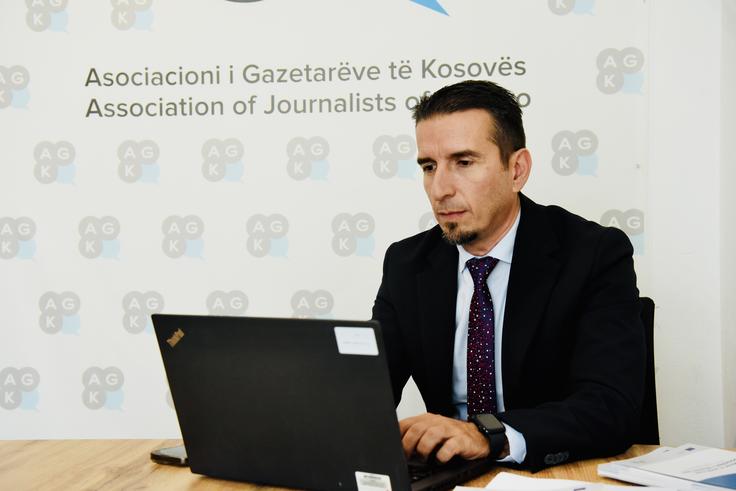
Yll Zekaj working on one of the ongoing cases.
Another important area is labour rights. The situation at RTK is particularly challenging in this respect, with journalists requiring ongoing advice on employment rights, disciplinary procedures, salary-related issues and the remedies available to them.”
We also see increasingly complex situations involving online harassment, threats, and the targeting of journalists, where the legal response may require simultaneous coordination with several institutions, or a single case can raise several legal issues at once. Online targeting, for example, may involve personal safety, privacy and criminal responsibility.
And then there are broader issues involving privacy, access to information, regulatory decisions and institutional interference with journalistic work.
What this tells us is that journalists today are not just dealing with the traditional question of physical safety; legal pressure, labour insecurity, online harassment and institutional pressure increasingly overlap.
What kind of legal advice or support do journalists most often seek, and how do you support their cases?
The support varies considerably depending on the case.
Journalists contact us when they receive a lawsuit, face an employment dispute, are threatened or harassed, need to report something to the Police or prosecution, or need clarification about their legal rights and available remedies.
In some situations, I provide immediate legal advice: explaining what the journalist should do, what documentation to preserve, and which institution to approach.
In other cases, I assist with preparing complaints, legal submissions or documentation for institutions such as the Labour Inspectorate, courts or law-enforcement bodies. I follow unresolved cases and communicate with the relevant institutions when necessary.
Another important part of my role is connecting journalists with lawyers who can provide pro bono representation. Through my professional network, the AJK has connected journalists with several lawyers willing to help.
So, the support often begins with a phone call or consultation, but depending on the case, it can develop into drafting, institutional follow-up, or full legal representation through another lawyer.
What difference does access to legal assistance make for journalists?
For journalists, I think the most important thing is knowing that when something happens, they are not left alone to understand the legal system while already dealing with the pressure of the incident itself.
A journalist who has just received a threat, a lawsuit, or a disciplinary decision from an employer should not have to spend days searching for someone who understands both the law and the specific circumstances of journalism and the legal procedures.
Having this mechanism means that they can call the AJK and receive legal guidance very quickly.
It is particularly important for journalists who cannot afford private legal representation. Through this service and the pro bono network that we developed, some journalists were able to access professional legal assistance that otherwise may simply have been financially inaccessible to them.
For the AJK, it also means that its interventions are legally grounded. When AJK reacts publicly, communicates with institutions, or raises a case with Police, prosecutors, or courts, there is legal expertise behind that response.
So legal assistance protects the individual journalist, but at the same time it strengthens the AJK as an institution.
"The continued engagement of a Legal Advisor has become essential to the Association of Journalists of Kosovo (AJK), not only as a source of legal expertise but as an integral part of AJK’s daily response mechanism for journalists facing legal, professional, labour-related and safety challenges.
Since the establishment of this function, legal support has evolved from occasional external assistance into a structured and continuously available service that strengthens both the protection of individual journalists and AJK’s institutional capacity."
Getoarbë Mulliqi
Executive Director, Association of Journalists of Kosovo
What is the key message you would like to share about the importance of legal assistance for journalists’ rights?
What I think is particularly important about this engagement is continuity. This is no longer a consultancy where AJK sends an occasional question and receives a legal opinion; it has become part of AJK’s daily protection mechanism.
Knowing the cases, the previous correspondence, the relevant institutions and often the history of an individual journalist’s case is essential. This institutional memory is important because when something happens at 10 or 11 pm, we do not have to start from zero.
After more than four years of providing support for individual cases, AJK’s engagement with different institutions, public advocacy, and reviewing internal procedures, I see the function as a bridge between journalists, AJK, lawyers, and the justice institutions.
Its value lies in combining immediate assistance to journalists with longer-term institutional work aimed at improving the environment in which journalists operate.
OSCE Impact
Contact
